
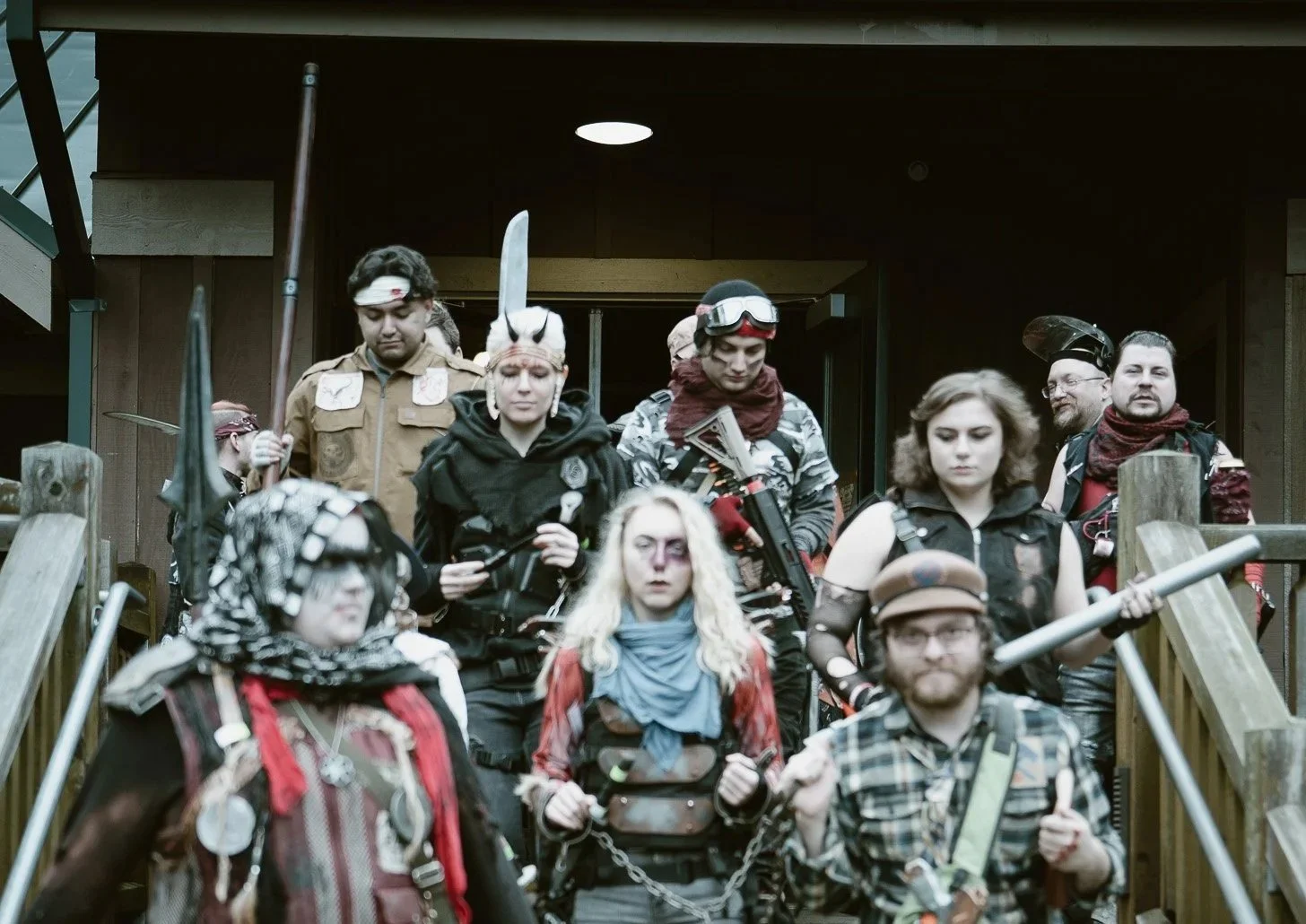
Blaster and Boffer Safety Standards
To ensure the safety and well being of each player, all contact-safe weapons that are brought into Dystopia Rising: The Anvil events must adhere to a rigorous set of safety standards.
These are outlined in depth in the ‘Dystopia Rising Live Player’s Guide’, p. 35-36.
Brawlers/”Knucks”: Between 12”-21” total length
Melee Small: Between 12-30”
Melee Standard: between 20-45”
Melee Florentine: between 20-40”
Melee Two-Handed: between 30-80”
Shield: Total surface area of less than 8’, with a minimum of 1.5 sqft, and a max height or width of 4’.
Thrown weapon:
No smaller than 5” in circumference
No larger than 13” along longest axis
Dystopia Rising Boffer Lengths
Boffer and Foam Prop Standards
General Safety Standards
Foam props must be designed for safe, controlled combat and should not cause harm during standard gameplay.
No sharp edges, hard cores, or exposed rigid materials at any point.
All weapons must pass a safety inspection before being used at an event.
Props should be lightweight but durable to ensure longevity while preventing excessive force in combat.
Excessively flexible or “whipping” weapons will not be permitted, as they can cause unintended injury.
Should have approximately 1” of foam padding on the pommel separating from any core or hard material.
——————————————
Permitted core materials:
Fiberglass, Carbon Fiber, FWET, PVC
Prohibited core materials:
Metal, wood, rigid plastic that can crack, splinter, or cause injury.
——————————————
Weapons should not be excessively flexible, as whips or overly bendable weapons can create unsafe impacts.
——————————————
Weapons with the following features will not be allowed in gameplay:
Metal or rigid embellishments, including screws, bolts, or decorative spikes. (Unless in handle, unintended for contact.)
——————————————
Signs that a weapon is unsafe and requires repair/replacement:
Exposed core, whether from foam breakdown or improper construction.
Torn, peeling, or missing foam layers, especially on striking surfaces.
Loose or failing adhesive points, causing foam layers to shift or detach. This can include cores detaching from foam.
Excessive flex or deformation, making the weapon unpredictable in combat.
——————————————
Staff Approval & Enforcement
All EVA foam weapons must pass staff inspection before they are used in gameplay.
If a weapon fails inspection, it must be repaired or removed from combat until it is deemed safe.
Game staff have final say on whether a weapon is safe, even if it meets technical guidelines.
Weapons up to 16” do not require a core, but are still subject to approval on a case-by-case basis. (Primarily for carded props that must qualify as a weapon, but are not intended for contact usage.)
Any player using an unsafe or non-approved weapon in combat may be subject to safety warnings or further action as deemed necessary by staff.
Blaster Safety Standards
All blasters are subject to approval by our safety team, and are required to fire at a ‘semi-auto’ or ‘single action’ (one dart per trigger pull) rate. The max FPS (feet per second) rate varies between 90-120, depending on the dart type. All blasters are tested using a chronograph upon Safety Check before game-on.
Foam Projectile Velocity by Weight Standards
1/2” darts < 1g: 120fps
1/2” darts < 1g: deliver no more than .67j kinetic energy
Foam Projectile Velocity limits:
All ½ inch darts- 120fps
“Rival” style balls- 110fps
3/4th inch “Mega” darts- 90fps
Nerf Mega XL, Ultra, and N1 darts should remain at commercially available velocities.
The following are approved dart manufactures, all other projectiles are subject to approval.
All Nerf brand projectiles-except dart tag velcro tips,
Worker Toy
Dartzone/Adventure Force
Zuru/Xshot
Gameface
The following are disallowed from play due to safety concerns.
Any projectile modified in any way from its commercial form
Nerf Vortex
NerfHyper
Nerf Nitro
ANY projectile with any type of hard or inflexible plastic exposed in any way